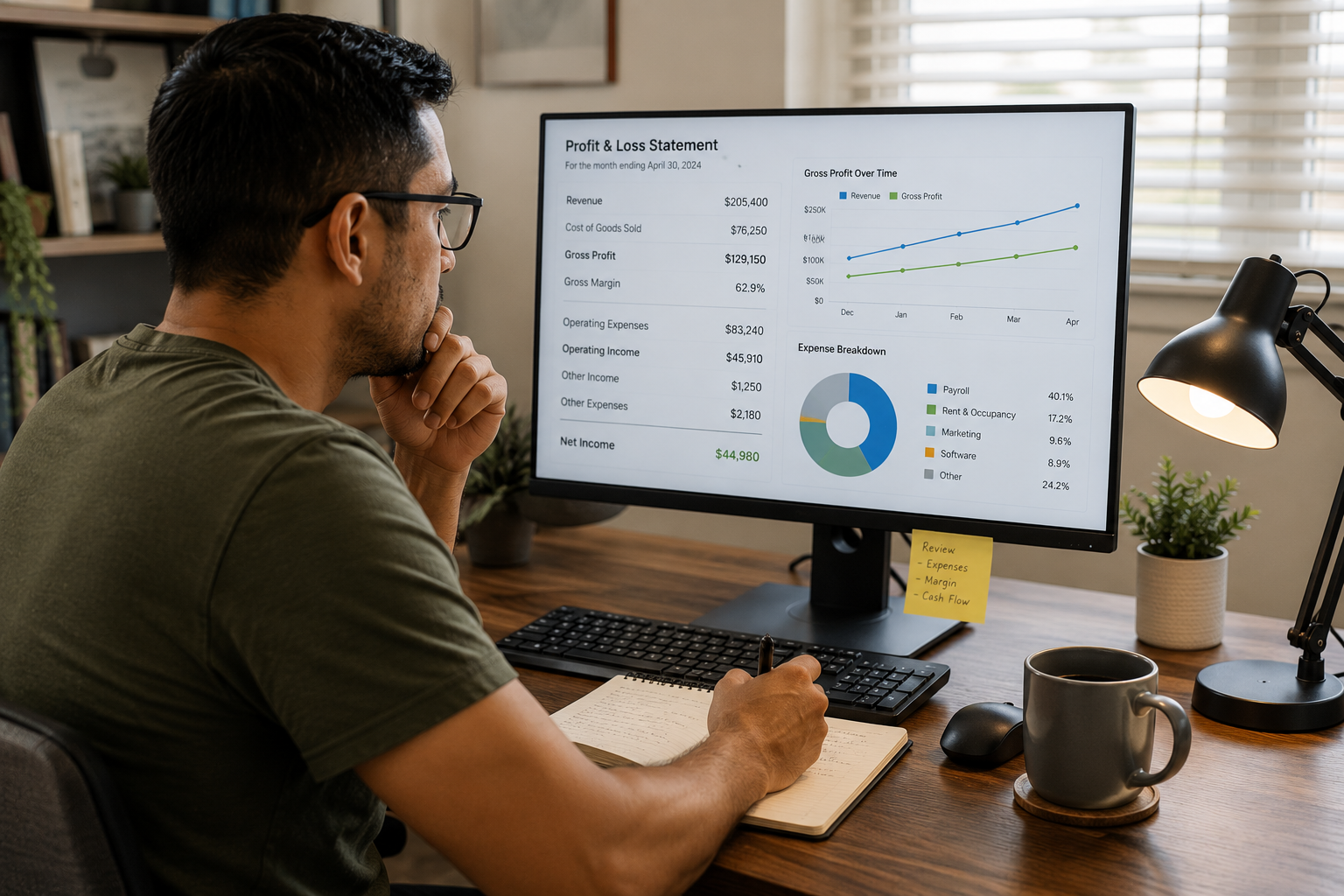
A profit and loss statement tells you whether your business made money, but that is only the beginning of what the report can tell you.
Learning how to read a profit and loss statement helps you understand where revenue comes from, what it costs to generate that revenue, where money is being spent, and what ultimately reaches the bottom line.
Do not read your P&L by jumping straight to net income. Start with revenue and work your way down through direct costs, gross profit, operating expenses, and net income. Then compare those numbers over time to understand what is changing in your business.
What Is a Profit and Loss Statement?
A profit and loss statement summarizes your revenue, expenses, and profit or loss over a specific period.
You may also hear it called a P&L statement or income statement. Businesses commonly review it monthly, quarterly, annually, or across a custom date range.
A typical P&L statement for small business includes:
- Revenue
- Cost of goods sold
- Gross profit
- Operating expenses
- Net income or net loss
The individual numbers matter, but the relationships between them tell you much more about business performance.
How to Read a P&L Statement Step by Step
When you are learning how to read a profit and loss report, start at the top and work downward. Each section provides context for the next.
1. Start With Revenue
Revenue shows how much your business earned from selling products or services during the reporting period.
Do not look only at the total. Compare revenue with previous months or years, review different products or service lines when available, and watch for seasonal patterns.
Revenue growth is useful, but it does not automatically mean profitability is improving.
2. Review Cost of Goods Sold
Cost of goods sold, or COGS, includes direct costs associated with producing or delivering your products or services.
Depending on your business, this could include inventory, materials, subcontractors, merchant fees, or direct labor.
Comparing COGS with revenue helps you understand how much it costs to generate sales.
3. Look at Gross Profit and Gross Margin
Gross profit is what remains after subtracting cost of goods sold from revenue.
Gross margin expresses that gross profit as a percentage of revenue. Together, these numbers can help you evaluate pricing and understand whether direct costs are consuming a larger share of sales.
A declining gross margin deserves attention even when revenue continues to grow.
4. Review Operating Expenses
Operating expenses cover the costs of running your business that are not directly tied to producing your products or services.
Common examples include payroll, rent, software, marketing, insurance, utilities, and professional services.
Look for expense trends rather than judging each number independently. An expense that increases consistently may deserve closer review, particularly when revenue does not increase at the same pace.
5. Check Net Income
Net income shows what remains after the expenses reflected on the P&L are deducted from revenue.
A profit and loss statement example may show strong revenue but relatively low net income. Working through each section helps you understand what happened between the top and bottom lines.
Do not evaluate net income alone. Profitability, margins, cash flow, and trends over time provide important additional context.
What Should You Look for Beyond the Numbers?
Understanding a profit and loss statement requires more than knowing what each line means. Financial analysis becomes useful when you compare numbers and ask why they changed.
For example:
- Is revenue growing faster than expenses?
- Is gross margin improving or shrinking?
- Which operating expenses have changed significantly?
- Is increased revenue producing higher net income?
- Are seasonal patterns affecting performance?
- How does this month compare with the same period last year?
Regular comparisons turn monthly financial statements into a tool for spotting patterns rather than simply recording history.
What a Profit and Loss Statement Does Not Tell You
Your P&L provides valuable information about profitability, but it does not show your complete financial position.
For example, net income does not tell you exactly how much cash you have available. Profit and cash flow measure different aspects of the business.
Your balance sheet provides information about what the business owns and owes, while a cash flow statement tracks how cash moves through the business.
Reviewing these financial reports together gives you stronger financial visibility than relying on your P&L alone.
How to Use Your P&L for Better Business Decisions
Once you understand the report, your P&L can support decisions throughout the year.
You can use it to evaluate pricing, control expenses, plan hiring, adjust marketing spending, create budgeting assumptions, prepare for tax planning, and identify potential growth opportunities.
The key is consistency. Reviewing QuickBooks reports or other financial reporting only at tax time gives you historical information, but regular reviews give you a chance to respond while those numbers can still influence current decisions.
Accurate Bookkeeping Makes Your P&L More Reliable
Your P&L can only reflect the financial information recorded in your accounting system.
Incorrect transaction categories, unreconciled accounts, or a poorly organized chart of accounts can distort revenue, expenses, and profitability.
Consistent bookkeeping helps ensure your financial reports reflect actual business activity. If maintaining those records has become difficult, knowing How to hire a Bookkeeper can help you evaluate the support you need.
Depending on your business, Virtual Bookkeepers or Outsourced Bookkeeping Services can also provide ongoing support without adding an internal bookkeeping position.
How Rise CPA & Accountants Helps You Understand Your P&L
Rise CPA & Accountants helps business owners move beyond simply receiving financial reports.
Our bookkeeping, accounting, and financial reporting support helps keep records accurate while giving business owners clearer insight into revenue, expenses, profitability, and financial trends.
The goal is to help you understand what your numbers are telling you so you can use them in business decision-making.
Ready to Get More From Your Financial Reports?
Financial reports should give you answers, not leave you wondering what the numbers actually mean.
Rise CPA & Accountants can help you keep your financial information accurate, understand what your reports are telling you, and use those insights to make more informed business decisions.